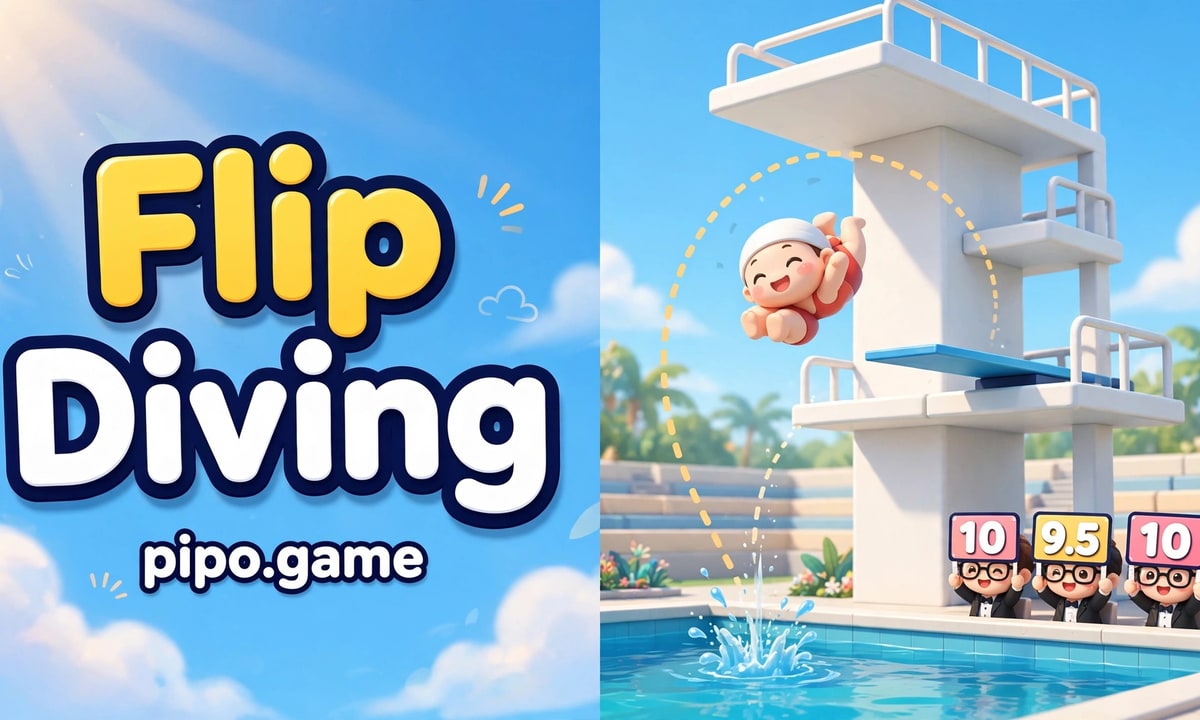
How to play Flip Diving
Choose Practice (pick a board and the wind) or Competition, then press Start. Your very first dive is a short tutorial on the 1 m springboard.
Before you jump, read the conditions card and the flag by the pool: the board, its height and the wind. The wind does not change during a dive.
Set the take-off angle with the arrow buttons or ←/→, from 0° to 35°. More angle sends you farther out and gives you more spin.
Hold the big button or Space to bend your knees and charge, then let go to jump. On a springboard, let go while the board is rising for extra height.
In the air, hold to tuck and spin faster, and let go to open out and slow the spin. Open in time to enter the water straight: hands first or feet first.
The physics of a dive
- Springboard timing The board dips and springs back about every 0.62 seconds while you charge. Let go as it rises and your launch is up to 22% faster; let go as it drops and you lose up to 8%.
- Tuck to spin Your angular momentum is set at take-off and kept all the way down. Tucking makes your body about 3 times more compact, so you spin about 3 times faster; opening out slows you again.
- Wind Wind pushes you sideways the whole way down, so it moves you much farther off a 10 m platform than off a 1 m board. Aim into it: lean out more against a wind that pushes you back.
- Distance from the board Enter too close to the board, or brush it on the way down, and the judges take points off. Fly too far out and you lose points too.
Splash and scoring
- The splash The splash grows with how far your body is from vertical, a tucked body at entry, the spin you still carry and the part that goes in first. A straight, steady entry makes a tiny rip, hands first or feet first.
- Belly flop More than 50° from vertical and your belly or back hits the water first: the biggest splash, a SPLAT, wincing judges and an "ooh" from the crowd.
- Judges and points Three judges mark the entry out of 10. Your points are ten times the mark, plus a rotation bonus, times the difficulty of the board and the wind.
- Rotation bonus Every half somersault adds a bonus from one full somersault up, but only when the entry mark is 6.5 or better. A messy multi-flip earns nothing extra.
- One tip after every dive The score card names the one thing that cost you most, such as "Over-rotated by 25°: open up earlier", "Too much spin at entry" or "The wind pushed you; aim a bit into it".
Modes
- Practice Any of 5 boards (1 m and 3 m springboards, 5 m, 7.5 m and 10 m platforms) and 4 wind levels from calm to strong. Retry keeps exactly the same conditions so you can compare dives; New wind draws a fresh one. Your best score for each condition is kept.
- Competition 3 dives that get harder: the 1 m springboard in calm air, the 3 m springboard in a breeze and the 10 m platform in a strong crosswind. The total goes to the leaderboard.
Flip Diving features
- Easy to start, deep to master A straight jump or a plain header off the 1 m board already scores well; experts stack 3½ somersaults off the 10 m platform and still rip the entry.
- A tutorial that waits for you The first dive teaches Hold to charge, Release to jump, Hold to tuck and Release to open in place, slowing the flight until you do each step.
- A bright cartoon stadium Colourful stands full of fans, a tall diving tower, a bending springboard, a flag that streams in the wind and a cut-away pool that shows your dive under the water.
- Sound and music A creaking board and a springy boing, whooshes that speed up as you spin, a crisp rip or a huge SPLAT, cheers, an "ooh", applause, wind that follows its strength and a bouncy summer tune.
More games like Flip Diving
- Bottle Flip Another flip game where the landing is everything.
- Circus Stunts More acrobatic timing and daring tricks.
- Bath Balance More water and balance, with a splash when it goes wrong.
 Bottle Flip
 Circus Stunts
 Bath Balance
 Grow Op
 Bladder Panic
 Last Train
 Reply All
 Camera On
Comments
Loading comments…